
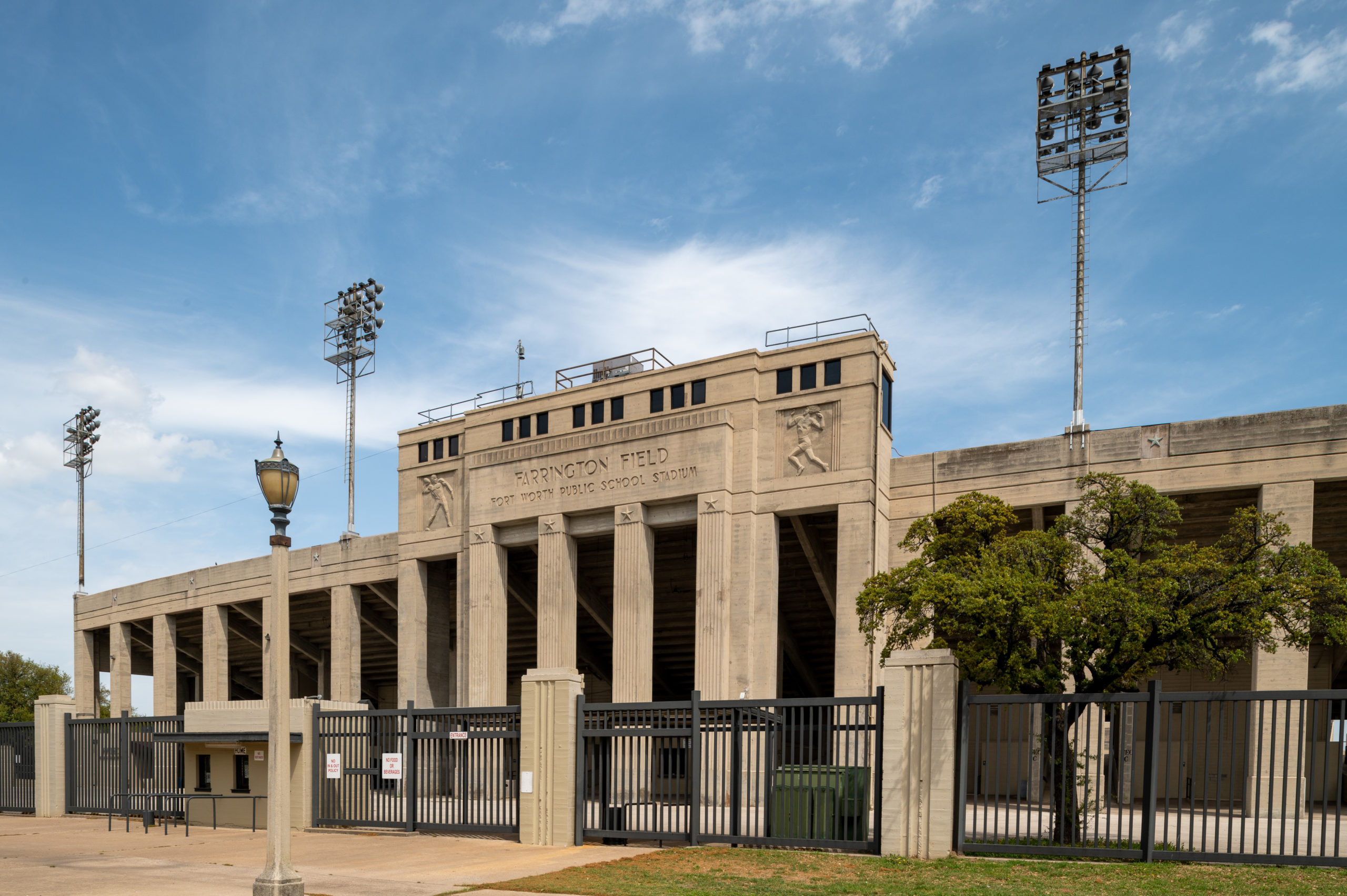
FWISD revises Farrington Field land development request after residents urge caution
The land around Farrington Field is back in play.
Fort Worth ISD issued a revised request for proposals on May 29 as it seeks developers for property surrounding the historic stadium. The development reset comes weeks after residents urged state-appointed district leaders to slow down, protect public ownership and preserve the site’s legacy.
The updated request for proposals seeks developers interested in purchasing and building across as many as seven tracts around Farrington Field. Proposals are due noon July 24, after FWISD extended its original July 9 deadline on Wednesday.
The stadium itself is not included in the potential sale. The district says it has no current plans to dispose of Farrington Field, which opened in 1939 and remains one of Fort Worth’s most recognizable landmarks.
The revised solicitation follows a May 20 community meeting where about 20 residents, preservation advocates and former elected officials raised concerns about the future of Farrington Field and the land surrounding it.
Their message was largely consistent: Slow down, protect public ownership and treat Farrington Field as something more than developable land.
Superintendent Peter Licata told residents at the meeting that FWISD could afford to spend more time reconsidering the request for proposals.
What the district could not afford, he said, was making the wrong decision, or feeling tainted that leaders did something wrong or too quickly.
The updated request still allows for a potential sale of land around Farrington Field. But it also says the district may consider a ground lease instead of an outright sale.
Residents and elected trustees have previously pushed for a lease structure, arguing it would allow Fort Worth ISD to keep long-term control of the property while generating recurring revenue.
District leaders have said they need a way to pay for major Farrington Field renovations without taking money from schools. A 2021 assessment estimated the stadium needed about $26 million in repairs tied to accessibility, safety and other facility needs, Deputy Superintendent Kellie Spencer said.
Licata and city leaders previously estimated bringing the stadium up to modern standards could cost between $50 million and $60 million.
“The problem is I don’t have $55 million. I can write a check, but it probably won’t clear,” Licata joked during the May 20 meeting. “But I don’t have $55 million to take from schools. I can’t do it. Our schools need it.”
The revised request asks developers to submit proposals under two possible structures: One assuming Fort Worth ISD does not participate in the tax increment reinvestment zone created by the city of Fort Worth, and one assuming the district does participate.
The city approved the tax district in June 2025 as a way to capture future property tax growth in the area and reinvest it into public improvements, including potential renovations to Farrington Field.
If Fort Worth ISD participates, the selected developer would be expected to invest at least $250 million in the land around the stadium, with completion expected no later than Dec. 31, 2031.
The idea is that new private development would raise property values around Farrington Field, generating future tax revenue that could help reimburse costs tied to preserving and improving the district-owned stadium.
The updated request also includes new language about preserving historic features and trees.
If a developer proposes purchasing the tract where Jack A. Billingsley Field House is located, the developer must describe plans to preserve the legacy and historic aspects of the building. The request also requires developers to include details on how they would preserve trees on the property to the maximum extent possible.
Preservation advocates previously raised concerns about Billingsley Field House, which sits next to Farrington Field and is part of the site’s historic legacy.
The restarting of the process came after elected trustees questioned whether Fort Worth ISD was moving too quickly before the state takeover shifted authority to a board of managers and superintendent appointed by Texas Education Commissioner Mike Morath.
For residents who spoke at the May meeting, the central question was not whether Farrington Field needs work — it was whether the district can pay for that work without permanently giving up control of public land.
Disclosure: FWISD manager Pete Geren leads the Sid W. Richardson Foundation, a financial supporter of the Fort Worth Report. FWISD manager Laurie George is a member of the Report’s reader advisory council. At the Fort Worth Report, news decisions are made independently of our board members and financial supporters. Read more about our editorial independence policy here.
Matthew Sgroi is an education reporter for the Fort Worth Report. Contact him at matthew.sgroi@fortworthreport.org or @matthewsgroi1.
This article first appeared on Fort Worth Report and is republished here under a Creative Commons Attribution-NoDerivatives 4.0 International License.