
Saving the Building Is Only the Beginning: The Challenge of Adaptive Reuse in Fort Worth
By Historic Fort Worth, Inc.
Saving a historic building is often described as if the hardest part is convincing someone not to tear it down.
In reality, demolition can sometimes be only the beginning of the challenge.
Once an owner decides to preserve an older building and give it a new life, the project can encounter a complicated maze of zoning requirements, parking regulations, building codes, accessibility standards, fire and life-safety requirements, permits and approvals. What makes sense for a building constructed decades ago may not fit neatly into regulations written for today’s development patterns.
That tension is at the heart of adaptive reuse—the practice of finding a new use for an existing building rather than replacing it with new construction.
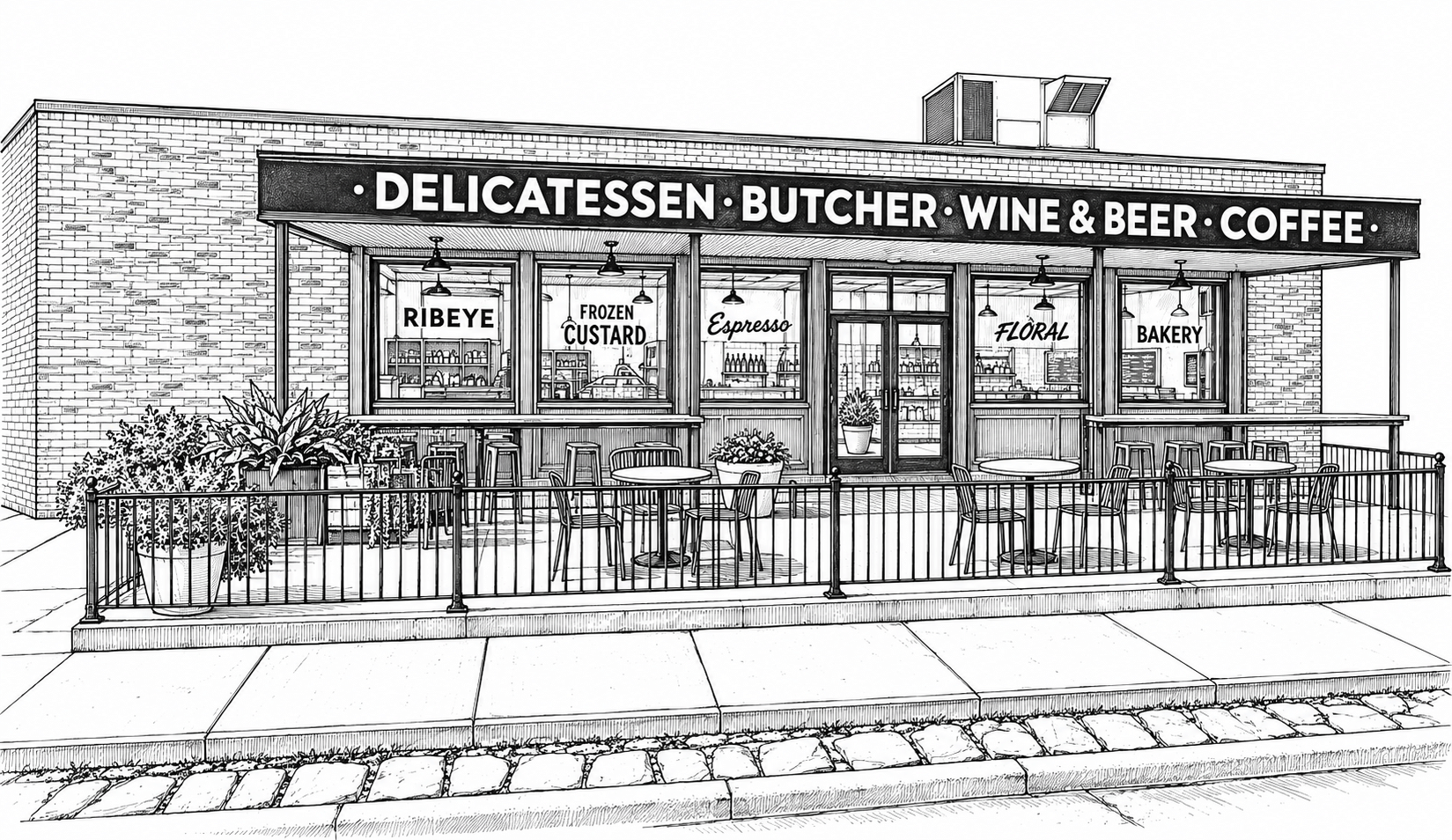
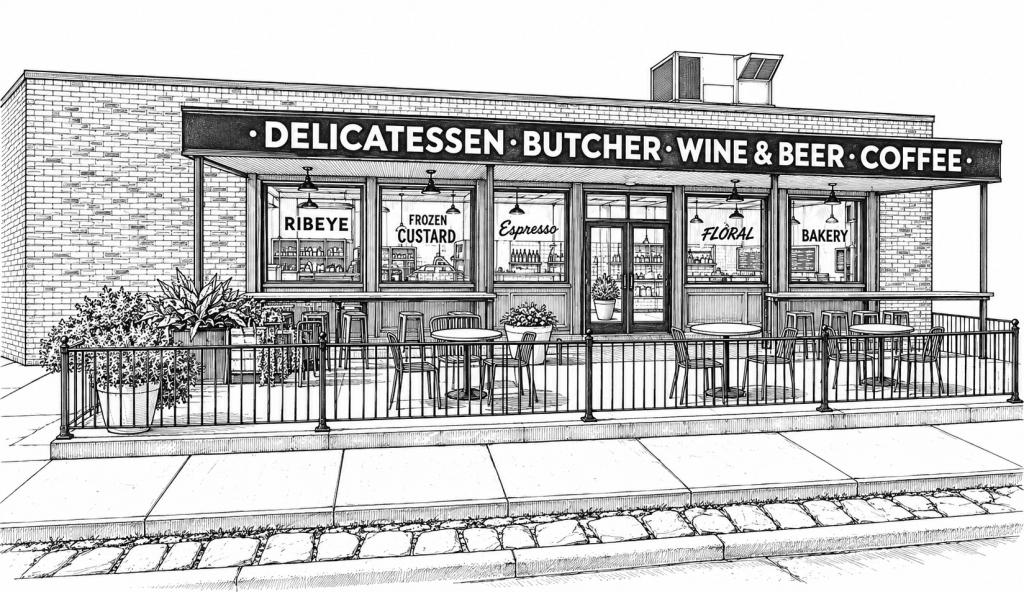
Fort Worth’s Roy Pope Grocery offers a current example.
The west Fort Worth institution opened in 1943 at 2300 Merrick Street and became a neighborhood landmark over more than eight decades. After closing in 2020, the property was given new life under new ownership and reopened in 2021 following an extensive renovation. The work included upgrades to plumbing, electrical and mechanical systems and changes to the interior while retaining the building’s basic footprint and identity. One account of the 2021 renovation noted that, from a purely financial standpoint, building new could have been easier than renovating the approximately 7,200-square-foot structure. (Fort Worth Magazine)
Now the property is facing another transition.
Roy Pope Grocery closed again on May 31, 2026, and Westland Hospitality is planning a new restaurant concept that will retain the Roy Pope name and draw on the property’s history and connection to the neighborhood. Fort Worth media have described the proposed transformation as the next chapter for a business that has been part of the city since World War II. (Fort Worth Star-Telegram)
But keeping an old building alive is not as simple as finding a new tenant.
The proposed change illustrates one of the fundamental challenges of adaptive reuse: the building may be historic, but the regulations governing its new use are very much of the present.
Fort Worth’s zoning system is intended to promote orderly growth and compatible land uses, and zoning requests go through the Zoning Commission before recommendations are made to the City Council. The City’s zoning policies address a broad range of concerns, including land use, transportation, infrastructure, economic development, urban design and historic preservation. (Fort Worth Texas)
That means an adaptive-reuse project can involve more than simply renovating walls, windows and mechanical systems. A change from one use to another can trigger questions about parking, traffic, accessibility, occupancy, fire protection, utilities, landscaping and other requirements.
Roy Pope’s current situation is an example.
The property is listed among Fort Worth’s current zoning cases as ZC-26-110, demonstrating that the proposed next chapter involves the City’s formal zoning process. (Fort Worth Texas)
The important distinction is that this is not a demolition case. The current proposal is intended to put the existing property to a new use. That is precisely what preservationists generally hope to see when an older building no longer functions economically in its original role: find a viable new use that allows the property to remain part of the community.
But adaptive reuse becomes much harder when the requirements attached to the new use make the existing building difficult or expensive to accommodate.
That is the preservation paradox.
A city can have policies that recognize the value of historic preservation while simultaneously having zoning, parking, building and permitting requirements that can make reuse challenging. None of those requirements necessarily exists because someone wants to eliminate a historic building. Each may serve a legitimate public purpose on its own. The difficulty comes when all of those requirements converge on a building that was never designed to meet them.
The result can be a financial equation that favors demolition.
A developer starting with a vacant site can design a building from the beginning around today’s parking requirements, accessibility standards, fire codes, utilities and commercial needs. An owner attempting to reuse an existing building must work within the limitations of a structure that may be 50, 80 or 100 years old.
That difference matters.
The 2021 renovation of Roy Pope illustrates the point particularly well. The renovation team had to upgrade the building’s plumbing, electrical and mechanical systems while adapting the existing structure for a modern food-and-beverage operation. The project’s developers said the renovation was formidable and that building a new structure could have been less expensive. (Fort Worth Magazine)
Yet the value of adaptive reuse cannot be measured only in construction costs.
When an older building disappears, the community loses more than square footage. It loses the physical evidence of its history—the storefront, the scale, the materials, the relationship to the street and the accumulated memories associated with the place.
Roy Pope demonstrates why that matters. The business opened in 1943, survived multiple ownership changes and economic challenges, closed once during the pandemic era, reopened and reinvented itself, and is now being reinvented again. Westland Hospitality has said it intends to retain the Roy Pope name and preserve the sense of familiarity associated with the institution. (Roy Pope Grocery)
That is preservation in a broader sense: not freezing a building in time, but allowing it to continue participating in the life of the city.
The lesson extends well beyond Roy Pope.
Fort Worth has thousands of older buildings and neighborhoods whose continued existence will depend on finding economically viable uses. Some are formally designated landmarks or located within historic districts. Others have no official designation at all but still contribute substantially to the character and identity of their neighborhoods.
For these buildings, adaptive reuse is often the difference between continued life and eventual abandonment or demolition.
That is why the preservation conversation needs to extend beyond the question of whether a building is historically significant.
The equally important question is:
Can we make it practical to keep the building?
That requires looking carefully at the entire development process. Zoning regulations, parking requirements, permitting procedures, building codes, accessibility requirements and preservation standards all have legitimate purposes. But if the cumulative effect makes reuse financially or practically impossible, the city can unintentionally create an incentive to replace the very buildings it hopes to preserve.
Fort Worth has an opportunity to approach adaptive reuse as a coordinated preservation strategy—one that recognizes that the best way to preserve many historic buildings is to make sure they have a viable economic future.
Roy Pope is not a story about a building that has been saved once and can now be considered permanently protected. It is a story about how preservation really works: one generation saves a place, another finds a new use for it, and each generation must solve a new set of challenges to keep it standing.
The preservation work doesn’t end when the wrecking ball is stopped.
Sometimes, that is when it begins.
Sources
City of Fort Worth, Development Services, Zoning — explanation of the City’s zoning system and review process. (Fort Worth Texas)
City of Fort Worth, Current Zoning Cases — listing of case ZC-26-110. (Fort Worth Texas)
City of Fort Worth, Historic Preservation — overview of the City’s historic-preservation review process. (Fort Worth Texas)
Fort Worth Magazine, “Behind the Deal That Turned Roy Pope from a Dying Grocer to a Foodie-Friendly Hotspot” — details on the 2021 renovation and adaptive reuse. (Fort Worth Magazine)
Fort Worth Star-Telegram, “An 83-year-old Fort Worth grocery is closing. Here’s what Westland plans next” — 2026 closure and proposed restaurant conversion. (Fort Worth Star-Telegram)
Fort Worth Magazine, “Westland Hospitality to Reimagine Roy Pope in Fort Worth” — background on the new restaurant concept and its stated intention to honor the property’s history. (Fort Worth Magazine)
Roy Pope Grocery, “Our Story” — history of the property and previous renovation. (Roy Pope Grocery)